Case study

The hard part was never finding the law.

A life insurer ran regulatory monitoring as a manual craft: a compliance team of two to three people watching national and EU legal sources, filtering hundreds of publications a month down to the five or ten that actually touch the business, by eye. FlowX.AI built a regulatory and compliance insight agent that scans the sources daily, decides what is relevant, classifies it into the insurer’s own legal categories, and reasons about its impact on the insurer’s written procedures, with a confidence score on every match and a human validating every judgement.

  • Insurance
  • Life insurance
  • Regulatory compliance
  • Human-in-the-loop
  • Native legal reading
  • FlowX.AI SaaS

Live in the pilot

Daily
Automatic scan, up from a monthly manual cycle
Same-day
Board awareness, from a lag of up to 30 days
~0
Internal procedures gap-scored, with confidence

What if the hard part of compliance was not finding the law, but knowing which five of several hundred publications actually matter?

The old way ran on reading and recollection. A compliance team of two to three people watched the national legal information system, an EU legal database, the national draft-legislation portal, the national insurance supervisor, EIOPA, the tax and anti-money-laundering authorities, the data-protection authority, and ministry and government pages. They collected the publications, decided by eye what was relevant, assessed the impact, and once a month formatted a compliance report for the management board and the board of directors. Gathering the laws was never the problem. Filtering them was.

The starting position

The pressure was not volume, it was judgement.

Regulatory monitoring, screening and impact assessment ran almost entirely by hand across a team of two to three. Four things defined the starting state.

2-3
People running all monitoring by hand
5-10
Relevant items a month, filtered from hundreds by eye
up to 0 days
Publication-to-board lag, structural
01

Judgement was the bottleneck, not gathering

Collecting the laws was never the problem. Out of hundreds of national and EU publications a month, perhaps five to ten actually touched the insurer, and that call was made by reading a title or a summary and drawing on know-how, sometimes on intuition.

02

Everything was manual, with no taxonomy to sort against

Sources were checked by hand, relevant developments spotted by eye, and impact judged from experience. There were no formal legal categories to classify against; the taxonomy simply did not exist.

03

Gap analysis lived in a separate world

Checking a new regulation against internal procedures, and updating those procedures, was a different workflow entirely. It sat outside monitoring and screening, and ran only when a matter was important enough to convene a working group.

04

The lag was structural

Up to 30 days could pass between a regulation being published and the board becoming aware of it, slowing strategic responses and budget approvals. A team of three could not widen its coverage without simply working more hours.

What changed

Five pressures, answered by the workflow.

The team no longer collects and formats. Each pressure now has a concrete answer, built to work with the sources, the procedures and the reporting rhythm that already existed.

  1. Pain point

    Two to three people manually check a long list of national and EU sources, filtering hundreds of publications down to the five to ten that matter, by eye.

    How we solved it

    A daily automatic scan captures everything published since the last run. The agent decides what is relevant to the life-insurance domain, classifies it, and extracts the metadata: publication date, number, type, status and stage, and the several deadlines a single law can carry.

  2. Pain point

    No formal legal categories existed, so classification depended on individual know-how and, in the team’s own phrase, intuition.

    How we solved it

    The agent classifies into categories the insurer defined, with descriptions in its national language and English written to guide it, and derives the impacted department from the owners of the impacted procedures.

  3. Pain point

    Gap analysis against around 100 relevant internal procedures (of around 300) ran as a separate, working-group-triggered workflow.

    How we solved it

    Opening a law shows the impacted procedures ordered by confidence score, each gap labelled missing, partial, leverageable or compliant, with an impact description, proposed next steps, and a department-level roll-up so each team sees only what concerns it.

  4. Pain point

    Up to a 30-day lag from publication to board awareness, with no deadline tracking attached to anything.

    How we solved it

    Monitoring now flows straight into deadline tracking. Impacted procedures carry a status (not started, in progress, updated) and an active-deadlines view aggregates them against thresholds: urgent under 45 days, upcoming 45 to 90, and beyond, with an overdue card for anything past due.

  5. Pain point

    The monthly board report was a manual assembly ritual, and laws that never appear online, draft acts received by email and agency guidelines, had no route into any system.

    How we solved it

    One button reproduces the report: choose the period and the sources, export to Excel for reuse in Word and PowerPoint, so the report becomes a by-product of the dashboard. A manual company-uploads channel feeds offline laws to the agent, which analyses them for gaps exactly like crawled sources.

The agent

What the regulatory-insight agent does.

It scans the sources daily, decides what is relevant, scores its own confidence against the insurer’s procedures, and hands a human a ranked queue to validate. Nobody re-reads a title to guess relevance any more.

01

Daily scan & relevance decision

An automatic daily scan captures everything published since the last run, with a guarded manual trigger as a once-a-day fallback. The agent decides which of the day’s publications are relevant to the life-insurance domain. One run serves all users.

02

Classify & extract

It classifies each relevant publication into the insurer’s own legal categories and extracts the metadata: number, type, status and stage, plus adoption, publication and entry-into-force dates. It reads natively in the insurer’s national language and English, with no translation round-trip.

03

Impact & gap analysis

Opening a law shows a summary, a timeline of dates, and the impacted procedures ordered by confidence score, each gap labelled four ways (missing, partial, leverageable, compliant) with an impact description, proposed next steps, and a department-level roll-up.

04

Track, report & calibrate

Deadline tracking runs against 45- and 90-day thresholds with an overdue card; one button exports the board report to Excel; and a per-procedure impacted / not-impacted control turns the team’s judgement into a training signal that calibrates the agent over time.

The hard part

Automating judgement, not just collection.

The value was never in gathering the laws. It was in deciding which ones matter, reading them in their own language, and getting better at both over time, on three moves.

Move 1

Decide relevance, not just collect

Gathering was never the hard part. The agent decides which of the day’s publications actually touch the life-insurance domain, the judgement that used to rest on reading a title and, in the team’s words, sometimes intuition.

Move 2

Read the law natively

The agent reasons in the insurer’s national language and in English, with no translation round-trip, so nothing is lost on the way in and classification runs against categories written in both languages.

Move 3feedback loop

Calibrate from human judgement

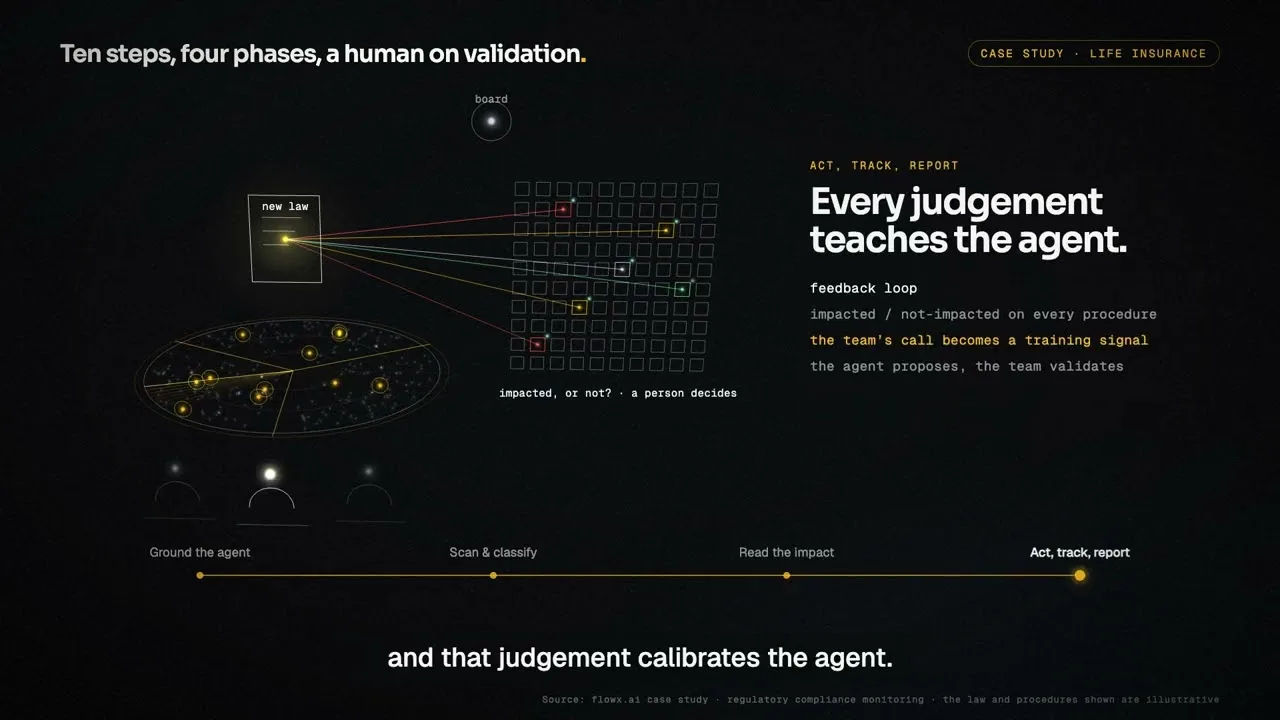
Every impacted procedure carries an impacted / not-impacted control. That feedback is how the agent is tuned, turning the team’s judgement into a training signal instead of throwaway effort, with reliance on review designed to diminish as reliability climbs.

The workflow

Ten steps, four phases, a human on validation.

From grounding the agent in the insurer’s own procedures to a board-ready export, with the agent proposing and the team validating every judgement.

Phase 01

Ground the agent

  1. 1

    Internal procedures

    The team uploads and maintains its ~100 relevant procedures, each defined by name, type and owner department, updated by re-uploading a new version so the latest text always wins. Fully filterable and sortable, with view, edit and delete on every entry.

  2. 2

    External legal sources

    For the pilot, three sources feed the agent, an EU legal database and two national sources, accessed through web crawling, plus a manual company-uploads channel for laws that never appear online. The wider source set is reserved for phase 2.

Phase 02

Scan & classify

  1. 3

    The daily run

    An automatic daily scan captures everything published between the last run and now, with a manual scan-sources trigger guarded to once a day as a fallback. One run serves all users.

  2. 4

    Identify, classify, extract

    The agent decides which of the day’s publications are relevant to the life-insurance domain, classifies each into the insurer’s legal categories, and extracts number, type, status and stage, plus adoption, publication and entry-into-force dates.

Phase 03

Read the impact

  1. 5

    The dashboard, in three streams

    Results land in one shared dashboard split into adopted laws, draft laws and company uploads, separated because they behave differently: drafts and uploads get a gap read but no procedure-status monitoring.

  2. 6

    Impact & gap analysis

    Opening a law shows a summary sized small, medium or large, the timeline of dates, the impacted procedures ordered by confidence score with four-way gap labels, an impact description, proposed next steps, and a department-level roll-up.

Phase 04

Act, track, report

  1. 7

    Feedback loop

    Every impacted procedure carries an impacted / not-impacted control. That feedback calibrates the agent, turning the team’s judgement into a training signal instead of throwaway effort.

  2. 8

    Deadlines & status

    Statuses (not started, in progress, updated) and an active-deadlines view against 45- and 90-day thresholds, plus an overdue card.

  3. 9

    Report export

    One button, with the period and sources selected, exported to Excel rather than PDF because the team reuses the data in Word and PowerPoint.

  4. 10

    Human in the loop

    The agent proposes, the team validates and feeds back. Data lives on FlowX.AI SaaS, EU-hosted.

Delivery

From kick-off to a live pilot.

The process and UI build landed on plan. The extra time went where it mattered: calibrating the agent’s judgement, and a mid-project decision to widen the tool from a document-diff into a regulatory radar.

Kick-off

Scope, roles, success criteria and governance agreed, with weekly status and bi-weekly demos. On plan.

Discovery

Two discovery sessions plus a prototype walkthrough; the end-to-end journey and business requirements agreed and signed off. On plan.

Building

The process and UI backbone delivered on plan: Sprint 1 on mock data, around 80% of screens, then the AI agent, its calibration, the national-language localization and the UAT environment.

Testing & UAT

The stretch that earned its time. AI calibration and validation took a few more iterations than planned, and a mid-project scope expansion, from gapping single procedures to reading the whole domain, widened the tool from a document-diff into a regulatory radar. Go-live followed shortly after UAT was completed.

The plan at kick-off was compact: two weeks of discovery, four weeks of build, two weeks of testing, with go-live targeted for early summer. The process and UI backbone landed on plan; the additional time went into AI calibration and validation, which took a few more iterations than expected.

A mid-project scope expansion did more than move a date. The moment the requirement grew from only gapping single procedures to reading the whole domain and then gapping, the tool stopped being a document-diff and became a regulatory radar.

Outcomes

What the pilot changed, in detail.

Three lenses on the same result: the coverage and speed it gained, the quality and control it now enforces, and the reporting and adoption it reshaped.

Coverage & speed

  • A monthly manual screening cycle became a daily automatic scan, with a guarded manual trigger as fallback.
  • Three legal sources live in the pilot, plus a manual upload channel for laws that never appear online.
  • Monitoring flows straight into deadline tracking against 45- and 90-day thresholds, with an overdue view: the piece the team never had.

A monthly ritual became a daily radar, and awareness that used to lag by up to 30 days now arrives the day a publication lands.

Quality & control

  • Every impact carries a confidence score: the agent’s probability that a given law affects a given procedure.
  • Gaps are labelled four ways (missing, partial, leverageable, compliant), each with an impact description and proposed next steps.
  • Classification runs against categories the insurer defined, in an organization that had no formal legal taxonomy before.
  • The agent reasons natively in the insurer’s national language and English, with no translation round-trip.

Relevance and impact are reasoned, scored and explained, in an organization that had no formal legal taxonomy before the project.

Reporting & adoption

  • The monthly board report regenerates from the dashboard: choose period and sources, export to Excel for reuse in Word and PowerPoint.
  • Department-level roll-up routes impact to the owning team, derived from procedure ownership.
  • Draft legislation is tracked separately from adopted law, with statuses and stages.
  • Deployed on FlowX.AI SaaS, EU-hosted, with a human validating every agent judgement.

The board report becomes a by-product of the dashboard, and every judgement the team makes teaches the agent.

Why it matters

From a monthly ritual to a living radar.

On the surface, this automates regulatory monitoring and impact assessment, useful and measurable in compliance-team hours saved and in closing the publication-to-board lag. Under the surface, it is the insurer’s first flow where an AI reads primary legal sources natively, decides what is relevant to the business, classifies it, and reasons about its impact on the insurer’s own written procedures, with a confidence score, four-way gap labels, an audit trail, and a human-in-the-loop feedback loop that calibrates it over time.

The scope pivot is the tell. The moment the requirement moved from only gapping a procedure to the whole domain plus gaps, the tool stopped being a document-diff and became a regulatory radar. It changes the compliance team’s day: a manual monthly screening ritual becomes a living radar, the board report becomes a by-product, and the team shifts from collecting and formatting to judging, with every judgement teaching the agent.

Phase 2 widens the radar. The remaining monitored sources, the national insurance supervisor, EIOPA, the tax and anti-money-laundering authorities, the data-protection authority, and ministry and government pages, come into the crawled set. Beyond that, the same pattern of native legal reading plus internal procedures, producing classified, confidence-scored, explainable impact with a full feedback trail, extends into media sentiment and law-version diffing. The pilot is proof that the radar can be widened.
About FlowX.AI

The orchestration platform for regulated work.

We are the enterprise orchestration platform that enables regulated institutions to deploy deterministic, zero-hallucination agentic workflows on top of legacy infrastructure. Insurers run critical customer and operations journeys on FlowX.AI, including:

  • Policy Onboarding
  • Claims Processing
  • Fraud Detection
  • Reinsurance
  • Underwriting Risk
  • Complaints & Disputes
  • Compliance
  • and more
Next

Put a regulatory radar inside your compliance team.

Bring a monitored domain and we will show you a path to production: native legal reading, relevance decided, impact gap-scored against your own procedures, the human in the loop and the audit trail intact.