Capacity was the ceiling
375-400 brokers averaged 2.7 mortgages a month at 60% utilization. The market was not the constraint; how much each broker could process was.
One of the largest credit brokerages and mortgage advisories in its market runs on 375-400 brokers intermediating between clients and more than 10 banks, each with its own products, DTI and LTV thresholds, age rules and income policies, all in constant motion. FlowX.AI built an AI Broker Assistant, two macro-agents on a shared, client-governed foundation, that returns bank-ready eligibility with traceable reasoning and answers brokers’ questions in natural language in under a minute.
Today, and validated results
The case study in 80 seconds
What if every broker reasoned like your best one, and hit 99% accuracy on multi-bank mortgage decisioning, with no human in the loop?
For years the expertise that made a deal possible lived in two fragile places: the seniors’ memory, and the WhatsApp groups where a junior would ask which banks accept a medical resident with seven months’ tenure, and wait for someone experienced to answer from recollection. Checking a client’s eligibility across 10 banks at once, with every co-borrower permutation, was hours of manual work. Capacity, not demand, was the ceiling.
Behind a 2.7-mortgage average sat an unequal distribution and a knowledge base that lived in people’s heads. Four uncomfortable truths defined the starting state.
375-400 brokers averaged 2.7 mortgages a month at 60% utilization. The market was not the constraint; how much each broker could process was.
Seniors carried large volumes because they held the rules of 10 banks in memory; juniors closed one or two a month and needed months to become productive. Institutional knowledge lived in recollection and in the archaeology of WhatsApp groups.
Ten banks, shifting DTI, LTV, age and income policies, and every co-borrower permutation, assessed by hand, one application at a time.
With around 50 new brokers planned per year, each hire cost 16 weeks of unproductivity plus hours of senior mentoring. Headcount alone was never going to bridge the gap, and the board needed speed without a heavy rebuild of the existing platform.
The rules of 10 banks moved out of memory and into a foundation the brokerage owns. Each structural pressure now has a concrete answer.
Institutional knowledge trapped in seniors’ memory and WhatsApp groups; juniors blocked, waiting on recollection.
Two macro-agents on a shared foundation, an Eligibility Agent and a Conversational Agent that reason like a senior broker. The week-4 junior now queries the system as effectively as the year-10 veteran.
Eligibility across 10+ banks, with every co-borrower permutation, taking hours per application.
The Eligibility Agent walks the entire catalog across 10+ banks from a single Excel upload and returns bank-ready decisions in minutes, with explicit reasoning.
Brokers unable to stay current on every bank’s product, policy and threshold; decisions riding on tribal knowledge, with rules in constant motion.
A hybrid architecture: deterministic wherever possible (catalog scanning, income calculations, DTI, LTV and age evaluation) and agentic only where genuine reasoning is needed (interpretation and recommendation).
No shared learning, no audit trail, no foundation for further automation.
Client-administered product and rule catalogs, daily per-user reporting, and complete logging of every question, answer and context. A source-traceable foundation the brokerage owns and updates itself, with no vendor dependency.
One assistant, two macro-agents: an Eligibility Agent that decides, and a Conversational Agent that answers, both grounded in the same client-governed knowledge base.
The broker uploads a simple Excel with the client’s data and presses a button. It walks the entire product catalog across 10+ banks and returns the top 3 products from the top 3 banks, with every calculation, the maximum obtainable amount, and explicit reasoning for the banks it excluded.
The assistant that replaces the WhatsApp group: natural-language questions over the documentation of 10+ banks, from catalog queries to the mini eligibility check hidden inside a simple question, answered in under a minute.
A hybrid architecture: deterministic for catalog scanning, income calculations and DTI, LTV and age evaluation; agentic only where genuine reasoning is needed, interpretation and recommendation.
Client-administered product and rule catalogs, daily per-user reporting, and complete logging of every question, answer and context. When banks change rates, the brokerage updates the knowledge base itself, with no vendor dependency.
The broker uploads an Excel and presses a button. An Orchestrator runs the profile through a chain of specialist sub-agents and returns a ranked, fully reasoned decision.
One Excel, one button
The broker uploads a simple Excel with the client’s data and presses a button. No forms to re-key.
The Orchestrator activates
An Orchestrator applies the shared Knowledge Base rules and dynamically activates the sub-agents the profile needs.
AI Income Validator
Normalizes and validates income, currencies and policy constraints, producing bank-ready income calculations per lender.
AI Product Decider
Matches the profile to products with a fit score.
Deterministic Rule Evaluator
DTI, LTV and age on configurable per-bank thresholds. Deterministic, not probabilistic.
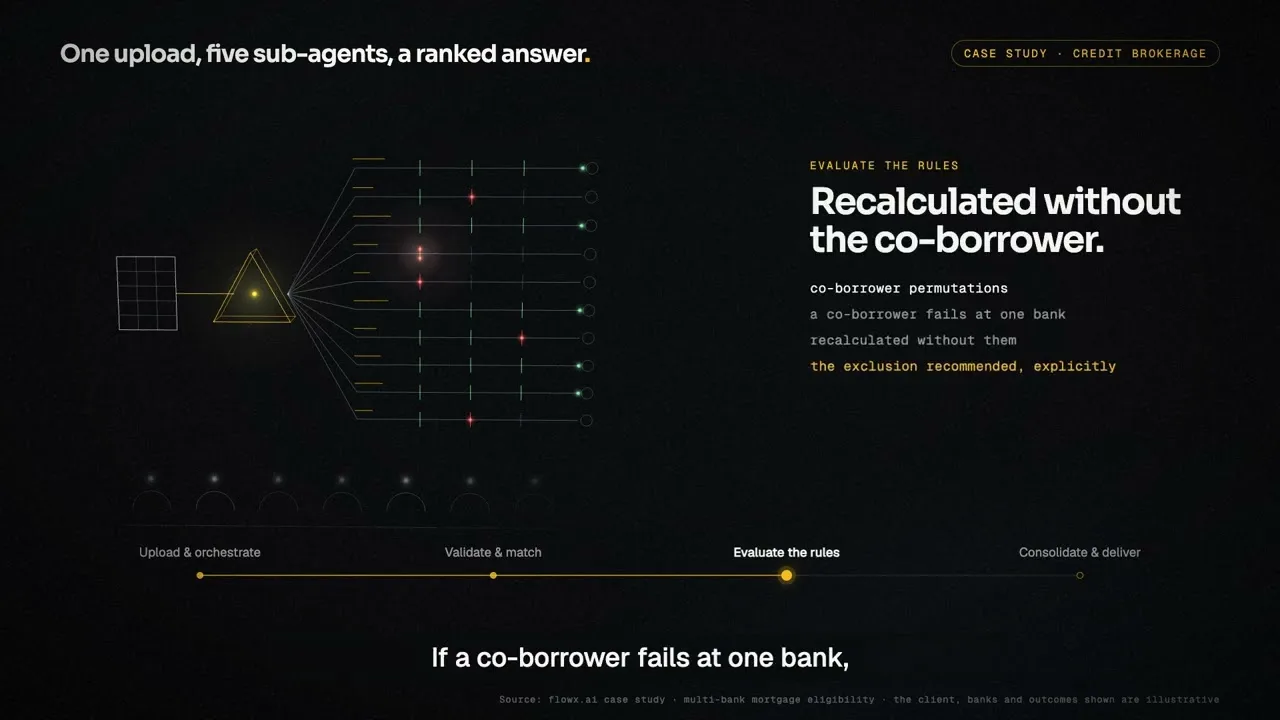
Co-borrower permutations
If a co-borrower fails at one bank, the system recalculates without them and explicitly recommends the exclusion for better chances.
Score & merge
The Eligibility Scorer and Product Merger consolidate the results and deliver the best-suited products with explicit rationale.
Top 3 from the top 3 banks
The top 3 products from the top 3 banks, the maximum obtainable amount, the full list of suitable products, and how income was computed for each.
Our own assessment put the realistic industry ceiling for a conversational assistant over documentation this dense at around 80%. The brokerage insisted on 99%. Getting there took engineering, not better prompting.
FlowX.AI gave us a way to scale broker capacity without scaling broker headcount, and turned our most expertise-dependent process into our most automated one.
The configuration went fast. The slip, about three and a half months, came from accuracy work that had never been sized as a phase of its own.
Contract
Execution defined: the 99% SLA and sub-1-minute response agreed, two-phase acceptance, a six-month pilot.
Build
Fast and clean. The product catalog and conversational demos landed in March; the eligibility module was solid from the start.
Accuracy challenge
The bottleneck. Three launches fell behind; on the same build, conversational accuracy swung between 54% and 81% in two days.
Recovery
All criticals resolved, a soft launch at 93%, and one final blocker: income questions, around 80% of real traffic. The team held the line: launch whole or not at all.
Production
Big-bang to all 375-400 brokers in a single rollout, exactly as the brokerage asked. 99% SLA met on the acceptance set.
The realistic industry ceiling for a conversational assistant over documentation this dense was around 80%. The brokerage insisted on 99% with no human in the loop. The team signed, and then did the engineering to get there.
The enablers of the recovery became durable product: section indexing, dynamic examples from past errors, scripted correction after every model call, and per-bank parallelization with aggregation. Every one is now a platform capability that every future client with dense documentation inherits.
The 99% accuracy is validated. These are the Year-1 targets the pilot is measured against, the numbers the old capacity model capped.
The AI Broker Assistant is Phase 1, and the proof point. The same agent builder, orchestrator pattern, shared knowledge base and guardrails that shipped it now become the foundation for the rest of the brokerage’s platform.
Phase 2 extends the assistant across the full operational workflow with five operational agents, Edge Case Capture, Email Automation, Campaign Monitor, Property Intelligence and Legal Assistant, each inheriting the existing knowledge base, orchestrator pattern and guardrails, so the delivery cost per new workflow drops sharply as the platform compounds.
Phase 3 delivers a full native-AI platform transformation: a guided digital data-capture journey, a configurable product catalog, an automated commissions catalog, a dedicated insurance module for cross-sell into mortgage journeys, and a unified task manager with SLA tracking.
FlowX.AI is the enterprise orchestration platform that enables regulated institutions to deploy deterministic, source-traceable agentic workflows on top of legacy infrastructure. Financial institutions run critical customer and operations journeys on FlowX.AI, including:
Bring a high-stakes, expertise-heavy process and we will show you a path to production, on your core, with source-traceable reasoning and the audit trail intact.