Key takeaways
- Freight companies are past asking whether to use AI. They are buying tools, building their own, or testing what their TMS ships with, and they came to F3 asking what comes next.
- The market is crowded with point solutions. Buyers are not short on AI tools; they are short on a partner they trust to connect them.
- Adoption is not the gap. Workflow change is. Research released the week of F3 put it plainly: 69% of organizations have moved beyond isolated AI use cases, but only 19% have significantly redesigned workflows around it.
- What we heard from the room: internal builds on general-purpose models get teams 70 to 80% of the way, and the ROI lives in the last stretch, where accuracy has to reach the high 90s before labor actually comes out of the process.
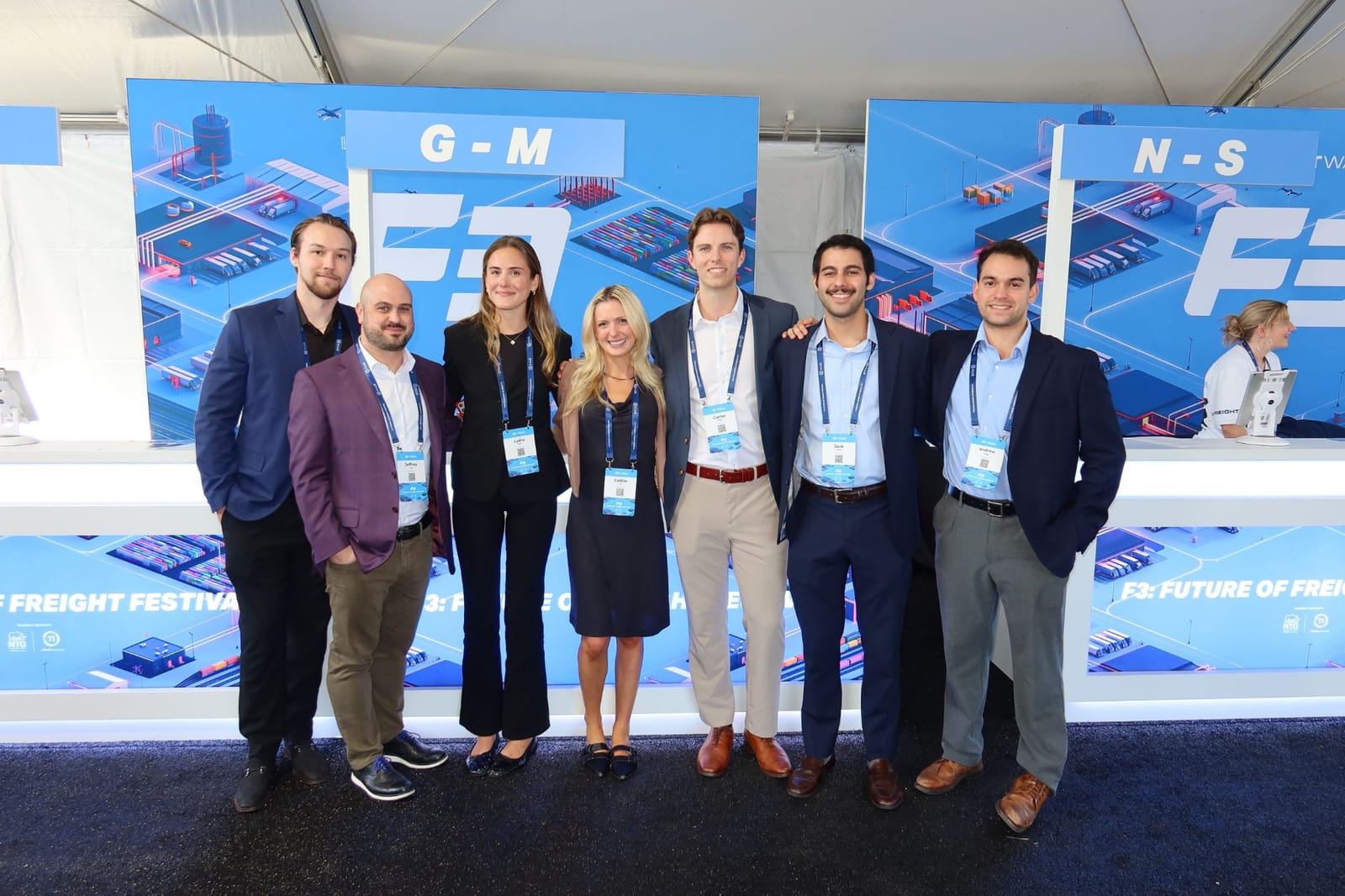
TL;DR: Seven colleagues from our logistics team spent two days at F3: Future of Freight Festival in Chattanooga, talking to brokers, shippers, carriers and 3PLs. Almost nobody asked whether AI belongs in freight. What they asked was how to make the tools they already have work together, inside the systems they already run, at an accuracy that actually pays back.
One of the most useful conversations our team had at F3 was with a freight broker who had just walked the vendor hall and come out underwhelmed. Not because the products were bad. Most of them did one thing well. His problem was that his business did not need one more thing. It needed the work moving between his business units to connect, and every booth was offering another app and another login.
That conversation turned out to be the week in miniature.
F3: Future of Freight Festival, FreightWaves’ annual gathering, took over The Signal in Chattanooga on October 27 and 28, 2026. Our US logistics team spent both days on the floor, at the booth and in the sessions, talking to brokers, shippers, carriers and 3PLs about where AI actually sits in their operations. When we compared notes afterwards, each of us had written down a version of the same story, from a different angle.
The freight industry has bought into AI. It has not yet changed how the work gets done. Here is what we heard.
Learning 1: Freight Is Past the Pilot Phase
At F3, the AI conversation did not start with whether. It started with what next.
Most of the teams we spoke with were already running something. Some had bought tools from outside vendors. Some were building their own. Several were doing both: one company we met used an external vendor for tracking and load entry while building internal tools on the side. Others were testing the AI features that now ship inside their TMS, and had come to F3 specifically to see what lies beyond them.
The build side has moved fastest. Over the last six months, a lot of freight companies have put real internal budget into building on general-purpose AI platforms from the frontier model providers. That is a meaningful shift. It means the people we talk to are no longer evaluating AI in the abstract. They have already tried to make it work, and they know where it stopped working.
That changes the conversation. A buyer who has never deployed AI wants to be convinced. A buyer who has deployed three tools and built a fourth wants to know why none of them talk to each other.
Learning 2: The Problem Isn’t Too Little AI. It’s Too Many Point Solutions.
If there was one word our team kept hearing, it was trust. Not trust in AI as a technology, but trust in who to buy it from.
The freight AI market has filled up with point solutions: one for load entry, one for track and trace, one for quoting, one for carrier communication, one for document processing. Each solves a real problem. Together, they turn AI adoption into a checklist. Operations leaders told us they feel like they are working through a list of tools they are supposed to have, rather than building toward something.
That creates hesitation, not enthusiasm. Many of the people we spoke with are still learning what AI can and cannot do, and the volume of vendors makes it harder, not easier, to decide. What they described wanting was closer to a long-term partner than another product:
- Someone who knows their business, not just the model behind the demo.
- Help shaping an AI roadmap, so each new capability builds on the last one.
- Fast implementation with measurable ROI, rather than another pilot.
- No new silo. Whatever they add has to plug into the stack they already run, starting with the TMS.
The broker from the vendor hall said it most directly. He did not need another app. He needed a way to connect workflows across his business units.
Learning 3: Adoption Isn’t the Gap. Workflow Is.
One number shared on stage captured the week better than anything we could write. It comes from Everest Group research released by Lean Solutions Group the day before F3 opened: 69% of organizations have moved beyond isolated AI use cases, but only 19% have significantly or extensively redesigned their workflows to support it.
That 50-point gap matches what we heard on the floor. The tools are in place. The work around them has not changed.
The conversations on the floor explained why. A large shipper described how hard it is to get AI tools working against their existing data. A broker described business units that barely communicate with each other, which means an AI tool deployed in one unit stops at that unit’s edge. In both cases, the model was not the constraint. The constraint was everything the model has to connect to: the TMS, the ERP, email, carrier portals, spreadsheets, and the people who move work between them.
This is also why the most consistent request we heard was not for a better model. It was for consolidation. People told us they wanted a platform that brings their AI tools together, integrates with the TMS they already run, and leaves room to expand later without starting over. We have written before that an AI strategy is only as strong as its integration layer. F3 was the most direct confirmation of that we have heard from the logistics market.
Learning 4: The ROI Lives in the Last 20 to 30%
The teams that built their own AI tools had the sharpest stories, because they had hit the wall themselves.
The pattern was consistent. An internal team builds on a general-purpose model and gets something working quickly. It handles most cases. Then progress slows. Some teams told us their tools break too often to trust in production. Others told us they could get 70 to 80% of the way to a working process, and that the last part was by far the hardest to finish.
That last part is not a detail. What we heard from the room was consistent: an AI tool that is right most of the time still needs a person checking all of its work, and the labor does not come out of the process until accuracy reaches the high 90s. Below that line, the tool adds a review step instead of removing a manual one, and the ROI case does not hold.
This was where our conversations went furthest. Closing that gap is not about a smarter model. It takes the parts that sit around the model:
- Integration with the systems of record, so the agent reads and writes real data instead of copies.
- Validation and exception handling, so low-confidence cases route to a person instead of passing through.
- Human oversight built into the workflow, so people review the cases that need judgment and nothing else.
- Security and reliability that hold up in production, not just in a demo.
When we talked through that final stretch with people who had already lived the first 80%, the platform conversation stopped being abstract. They knew exactly what was missing.
Learning 5: Two Signals From the Main Stage
XPO founder Brad Jacobs took the main stage at F3, and two of his points stayed with our team because they connect directly to what we heard on the floor.
Speed on spot quotes is becoming a competitive edge. Jacobs said he is more bullish on spot freight than on dedicated. With diesel prices as volatile as they are, dedicated freight is harder than ever to price accurately while protecting margin. If the market does tilt further toward spot, winning a spot quote gets more competitive, and the teams that can answer a shipper fastest with an accurate price gain a real advantage. That is exactly the kind of workflow where the last 20% matters: a fast quote that is wrong costs more than a slow one. That is also why quoting is one of the logistics workflows we build agents for.
Guardrails decide which way AI goes. Jacobs put the odds of AI making the world much better rather than much worse at roughly even, and said the deciding factor is appropriate guardrails. For an industry that is about to let AI agents quote, book and communicate on its behalf, that is not a philosophical point. It is an operating requirement.
What It Adds Up To
Put the five learnings side by side and they describe one problem from five directions. Freight has moved past experimenting. It has more AI tools than it can connect. The tools sit on top of workflows that have not changed. The internal builds stall short of the accuracy that pays back. And the people running the industry are telling it, from the main stage, that speed and guardrails will decide who wins.
None of that is a model problem. It is an operating problem: connecting AI to the systems freight already runs, redesigning the work around it, and governing it well enough that people trust it with real loads, real quotes and real customers.
That is the problem we built FlowX.AI to solve. One platform that connects to the TMS, ERP and carrier systems already in place, runs agents across workflows instead of inside a single tool, and keeps people in control of the decisions that need them. It is how freight teams get from the first 80% to production.
Thank you to everyone who stopped by our booth, sat down for a conversation, or told us honestly what is not working yet. We learned a lot, and we will be back.
Explore how FlowX.AI brings AI agents into logistics operations, or book a demo to see it on your own workflows.
Frequently Asked Questions
What is F3: Future of Freight Festival?
F3 is FreightWaves’ annual freight industry festival in Chattanooga, Tennessee. The 2026 edition ran on October 27 and 28 at The Signal, bringing together brokers, shippers, carriers, 3PLs and freight technology companies for two days of sessions, demos and networking.
How are freight companies using AI in 2026?
Based on our conversations at F3, most freight companies are already using AI in some form. Common patterns include buying point solutions for tasks such as tracking and load entry, testing the AI features built into their TMS, and building internal tools on general-purpose models. Many run more than one of these at once.
Why isn’t AI adoption in freight producing more ROI?
Two reasons came up repeatedly. First, most tools solve one task and do not connect to the wider workflow, so the work around them stays manual. Second, what we heard from the room is that internal builds often stall at 70 to 80% accuracy, while removing labor from a freight process takes accuracy in the high 90s. Research from Everest Group and Lean Solutions Group found that only 19% of organizations have significantly redesigned workflows around AI, even though 69% have moved beyond isolated use cases.
What do freight buyers want from an AI vendor?
The people we spoke with at F3 wanted a long-term partner more than another tool: someone who understands their operation, integrates with the TMS and systems they already run, helps them plan an AI roadmap, and delivers measurable ROI quickly without creating a new silo.
How does FlowX.AI approach AI in logistics?
FlowX.AI is a platform for running governed AI agents across enterprise workflows. In logistics, that means agents for work such as quoting and track and trace that connect to existing systems of record, route exceptions to people, and keep a full audit trail of every decision.